


Introduction
Most Australian businesses treat web security as an IT expense something that sits in the background, managed by your tech team and invisible to the outside world. But in 2026, that assumption is costing brands real revenue.
Security is no longer invisible. Google can read it. AI search systems factor it into citation decisions. And your customers consciously or not are scanning for it before they ever fill out a form or pick up the phone.
Whether you’re a law firm in Sydney, a healthcare provider in Melbourne, or an e-commerce brand serving customers across Australia, your security posture has become a public-facing brand signal. The good news? If you get it right, it becomes a competitive advantage that most of your competitors are still ignoring.
How Google reads your security in 2026
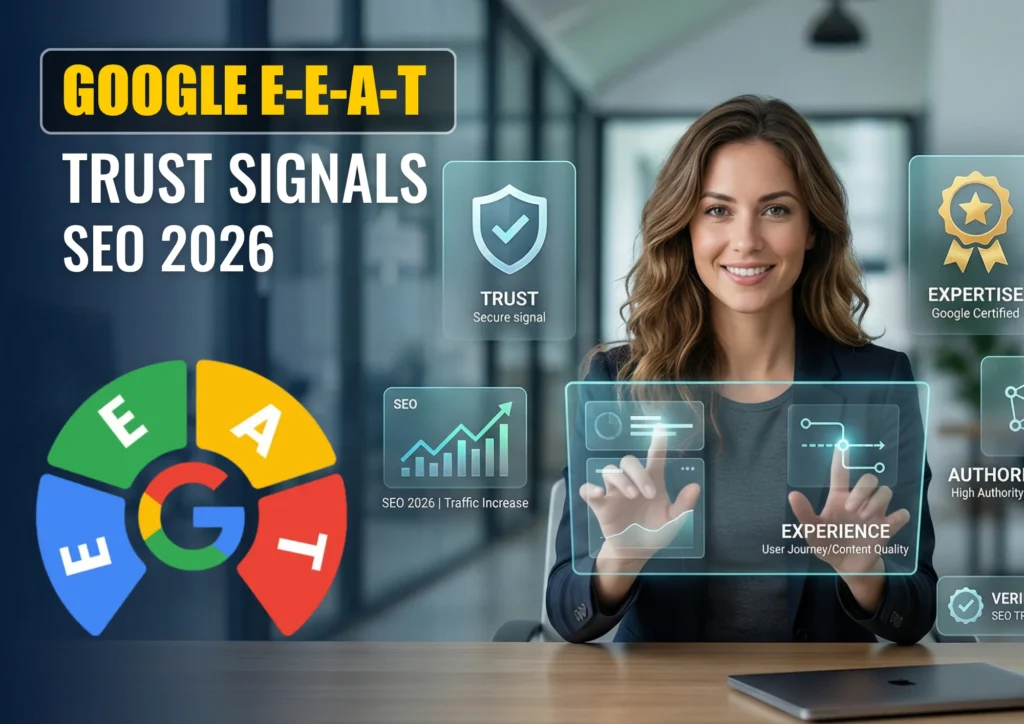
Search engine optimisation has always been about trust but in 2026, Google is more explicit than ever about the role security plays in rankings.
HTTPS is now a non-negotiable baseline. Sites without SSL certificates are actively flagged as “Not Secure” in Chrome, which immediately raises bounce rates and signals to Google that your site may not be safe for users. This directly affects where you appear in search results.
Beyond HTTPS, Google’s E-E-A-T framework which stands for Experience, Expertise, Authoritativeness, and Trust uses security-related indicators as part of its overall trust assessment. A site with verified business information, secure contact forms, clean architecture, and no malware history will consistently outperform one that treats security as an afterthought.
AI-powered search engines like Google’s Gemini, ChatGPT Search, and Perplexity also factor brand reputation and site safety into which sources they choose to cite. If your site looks unreliable to a crawler, it won’t be cited by an AI.
The implication is clear: your security setup is now part of your SEO strategy, whether you planned it that way or not.
Trust signals that turn visitors into buyers

Security doesn’t just affect where customers find you it affects what they do when they arrive.
Think about your own behaviour as a buyer. Before you submit a contact form, hand over your email address, or make a purchase, you instinctively scan the page for signals that tell you it’s safe. That padlock in the browser bar. A visible privacy policy. Recognisable security badges. Transparent contact details with a real address.
These are trust signals, and they function as purchase permission. Websites that display them clearly see measurably lower bounce rates and higher form completion rates. Websites that don’t create unconscious friction the kind that causes visitors to quietly close the tab.
For Australian businesses, three trust signals are non-negotiable in 2026:
- SSL certificate active across your entire website not just the checkout page
- A clear, plain-language privacy policy that references Australian Privacy Act compliance
- Verified contact information including a physical address, ABN, and phone number
Each of these costs relatively little to implement, but the compounding effect on conversion rates particularly for professional services, healthcare, and B2B businesses is significant.
What ISO 27001 actually signals to your market

ISO 27001 is the internationally recognised standard for information security management. It requires organisations to systematically identify risks, implement controls, and maintain ongoing review processes that protect client data and business information.
In 2026, it has become increasingly common as a procurement prerequisite particularly for businesses working with enterprise clients, government departments, or any organisation that handles sensitive personal or financial data.
But its value as a marketing asset goes beyond compliance checkboxes. When an agency or service provider displays ISO 27001 certification, it eliminates the lengthy security questionnaires that often slow down procurement decisions. It tells a potential client: we have already done the work to prove we take security seriously at an institutional level.
For Australian SMEs looking to win larger contracts or break into government work, ISO 27001 certification is increasingly a door-opener rather than a nice-to-have.
SysCare Digital’s background in IT managed services means this is baked into the way we build and manage digital solutions not something bolted on after the fact. When we build your website or manage your digital marketing, certified security practices come as standard.
4 ways to make your security visible and marketable

Understanding the value of security is one thing. Making it visible to Google, AI systems, and your customers is another. Here are four practical steps Australian businesses can take right now.
- Display your credentials prominently. If your agency or technology provider holds ISO 27001 or similar certifications, feature them in your website header, footer, and key service pages. Don't bury them in a PDF no one reads.
- Publish a transparent privacy policy. Write it in plain language. Make it easy to find. Ensure it references compliance with the Australian Privacy Act 1988 and, where relevant, GDPR for international customers. This is both a legal requirement and a conversion-boosting trust signal.
- Secure your entire digital stack. HTTPS on every page, a web application firewall, regular vulnerability testing, and a clean malware history. Security is only as strong as its weakest point one unsecured subdomain can undermine everything else.
- Create content around your security practices.A dedicated page explaining how you protect client data builds authority with both human visitors and AI search systems. It also signals to Google that your site is the kind of trustworthy source worth ranking and citing.
Each of these is a dual-purpose asset: it protects your business from real-world risk and signals credibility to the systems that decide your digital visibility.
Conclusion
In 2026, the line between IT security and digital marketing has effectively disappeared. Your security posture is visible to search engines, cited by AI systems, and scrutinised by buyers before they ever reach out.
Australian businesses that treat security as a marketing asset not just an operational cost will rank higher, convert better, and win the trust of clients who increasingly know what to look for.
Ready to build a website that Google trusts and customers feel safe on? SysCare Digital builds security-first digital experiences for Australian businesses. Get in touch for a free strategy session today.
